Reforms to El Salvador’s Immigration and Foreigners Law: The New Migration Paradise?
Reforms to El Salvador’s Immigration and Foreigners Law: The New Migration Paradise?

- San Salvador, March 23rd, 2026
The reforms approved by the Legislative Assembly to the General Law on Migration and Foreigners reduce the minimum stay requirement for temporary residents from:
9 months (approximately 275 days) in cases of leaving the territory for 90 consecutive days;
8 months (approximately 240 days) in cases of leaving for 120 days intermittently;
to just 90 days of continuous stay, facilitating mobility for investors and professionals.
These measures, combined with incentives for the diaspora such as duty-free importation of goods up to $100,000, aim to position the country as a regional hub for global talent.
But what benefits do foreigners obtain?
Drastic reduction in minimum stay: It went from 9 months (or not being absent for more than 90 days), 8 months (or not being absent for more than 120 days), to only 90 days per year (consecutive or cumulative) to maintain temporary residency. Ideal for digital nomads and investors who travel frequently without worrying about losing their legal status.
Ultra-fast processing: Temporary residencies are granted in approximately 5 days (the Special Law on Migration and Foreigners establishes a minimum of 45 business days for a response). However, timelines and procedures for granting residency have been streamlined.
All of this is in addition to the benefits already established in previous reforms we discussed in an earlier article, which include direct access to permanent residency for those who join investment or government programs, without the need to go through mandatory temporary residency first. See here: https://livinlikealocal.com/post/new-blog-post
The cost-benefit for both foreigners and nationals comes from the boom in foreign investment, making El Salvador more competitive than in previous years. It is worth noting that Salvadorans will see growth in indirect employment (construction, services), a sector that has a direct impact on the country’s GDP.
However, you should understand the difference between temporary and permanent residency:
• Temporary: Granted for 1–2 years, renewable up to a maximum of 5 years; requires 90 days of annual stay post-reform. Ideal for market testing or extended tourism.
• Permanent: After 5 continuous years of temporary residency (or less through marriage/naturalization, approximately 2 years), it allows indefinite work and provides a direct path to citizenship; total process ~5 years in most cases.
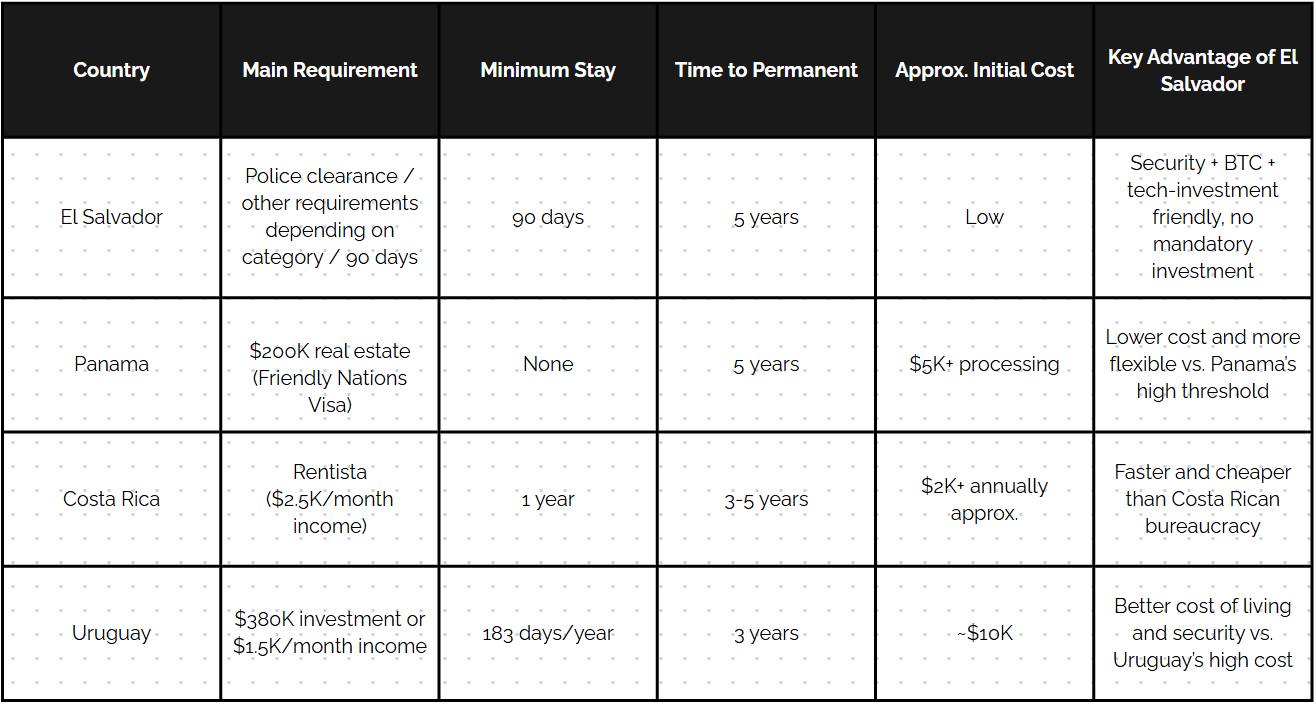
Comparative Table
El Salvador emerges as superior due to its unique combination of security (homicide rate reduced by ~90% since 2019), legal Bitcoin status, and minimal requirements, surpassing competitors in accessibility and cost.
So, why choose El Salvador?
It outperforms Panama (high bureaucracy and cost), Costa Rica (delays and high income requirements), and Uruguay (high financial thresholds), thanks to processes under 30 days, lower cost of living, top-tier security in Latin America, and Bitcoin as legal tender for instant transactions. Ideal for tech entrepreneurs and retirees.
Impacts and GDP projections
Economically, it is expected to boost GDP by +1.5–2.5% annually through foreign direct investment (FDI), similar to Panama (+2% GDP from visas in 2025). With 10,000 new residents, it could generate $500M in FDI and 20,000 jobs within 3 years.
Culturally, it will increase diversity in tech and tourism; infrastructurally, it will provide funding for airports and hospitals, easing pressure through taxes from new residents—provided the government’s strategy successfully attracts foreigners.
